Kabtafer Plus Editorial Team · Last reviewed: 15 October 2026
Sources: WHO haemoglobin guideline (2024), Mayo Clinic, NHLBI, NIDDK, NHS, BSG guideline (Gut 2021) and Kim & Tridane (PLoS ONE 2017).
The short answer
Haemoglobin (Hb) is the protein in red blood cells that carries oxygen. The World Health Organization defines a low level, which is anemia, as below 12.0 g/dL in non-pregnant women and below 13.0 g/dL in men aged 15–65, with lower thresholds in pregnancy and childhood. A low number tells you that something is wrong, not what. Iron deficiency is the most common reason, but vitamin B12 or folate deficiency, chronic inflammation, kidney disease, inherited conditions such as thalassaemia trait, and blood loss can all lower haemoglobin. Your doctor needs further tests to find the cause before any treatment is chosen.
Have your lab report? Use our free iron blood test checker →
Key points
- WHO 2024: anemia is Hb below 12.0 g/dL in non-pregnant women and below 13.0 g/dL in men.
- Below 8.0 g/dL is severe anemia in non-pregnant adults; below 7.0 g/dL in pregnancy.
- g/dL × 10 = g/L, so 12.0 g/dL is the same as 120 g/L.
- Lab reference ranges vary; read your result against your own lab’s range and with your doctor.
- In the UAE, thalassaemia trait is a common reason for low Hb with small red cells, and iron does not correct it.
What is a low hemoglobin level?
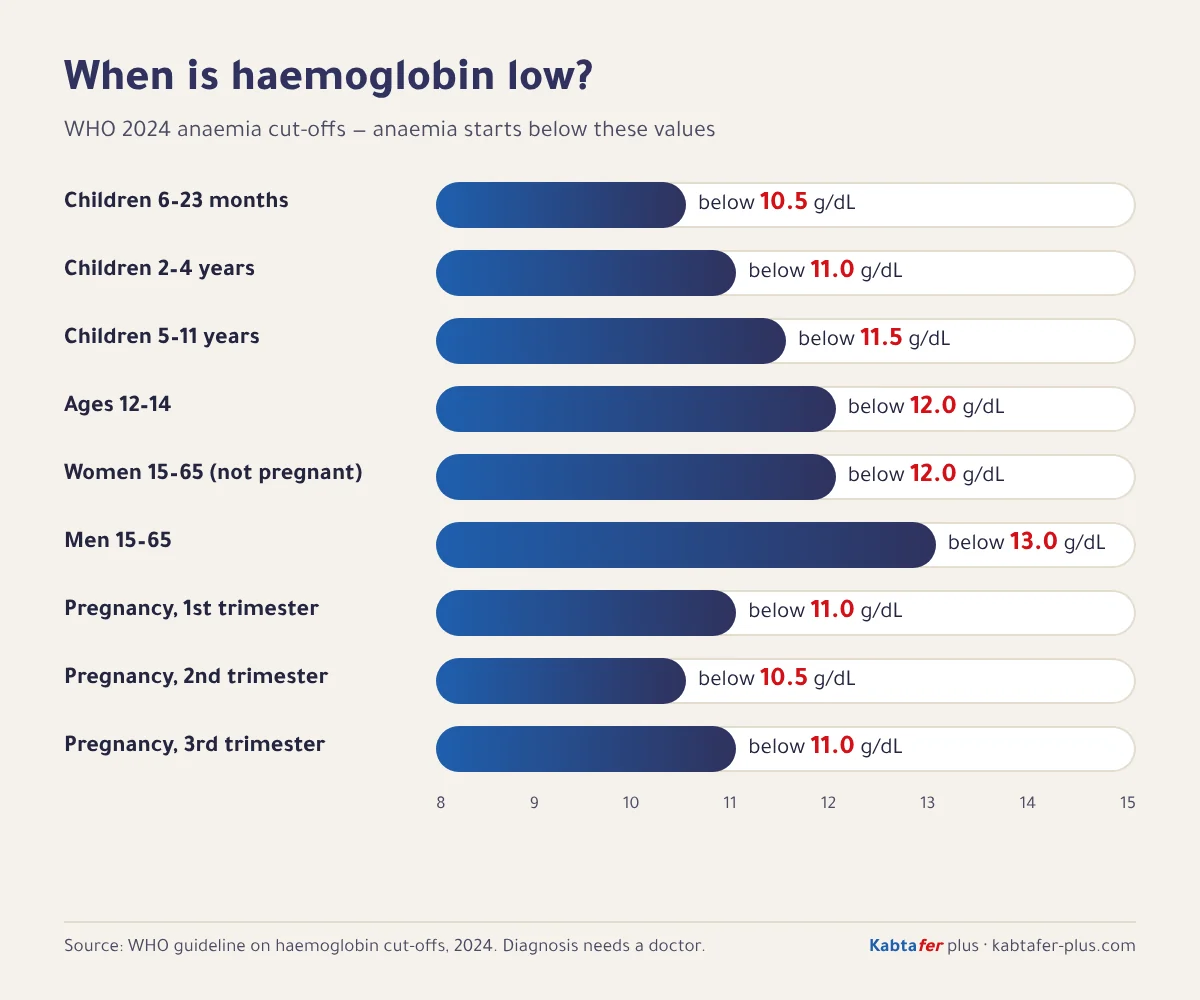
These are the cut-offs from the WHO guideline published in March 2024. A value below the threshold for your group means anemia.
| Group | Low (anemia) if Hb is below |
|---|---|
| Children 6–23 months | 10.5 g/dL |
| Children 24–59 months | 11.0 g/dL |
| Children 5–11 years | 11.5 g/dL |
| Adolescents 12–14 years | 12.0 g/dL |
| Non-pregnant women 15–65 | 12.0 g/dL |
| Men 15–65 | 13.0 g/dL |
| Pregnancy, 1st trimester | 11.0 g/dL |
| Pregnancy, 2nd trimester | 10.5 g/dL |
| Pregnancy, 3rd trimester | 11.0 g/dL |
How low is too low? WHO severity bands
| Group | Mild | Moderate | Severe |
|---|---|---|---|
| Non-pregnant women 15–65 | 11.0–11.9 | 8.0–10.9 | <8.0 |
| Men 15–65 | 11.0–12.9 | 8.0–10.9 | <8.0 |
| Pregnancy, 1st and 3rd trimester | 10.0–10.9 | 7.0–9.9 | <7.0 |
All values in g/dL. Some labs print slightly different reference ranges; those ranges describe the population the lab measured, while the WHO figures define anemia. Your doctor reads both together.
g/dL or g/L: reading the units
Some labs print haemoglobin in g/dL and others in g/L, so a report from one hospital can look very different from another. The conversion is simple: multiply g/dL by 10. A result of 11.2 g/dL is 112 g/L; a WHO threshold of 12.0 g/dL is 120 g/L. If a number on your report looks ten times too high or too low, check the unit before worrying.
Causes of low hemoglobin
The Mayo Clinic groups the causes into three: the body makes too few red cells, destroys them too fast, or loses blood. The ones doctors in the UAE see most often are:
- Iron deficiency. Very common, especially in women of reproductive age. Low ferritin usually comes first; see iron-deficiency anemia and ferritin levels.
- Vitamin B12 or folate deficiency. These typically produce red cells that are larger than normal (NHS). B12 deficiency can follow pernicious anaemia, a diet low in animal foods, or long-term metformin or PPIs; low B12 can also cause tingling and walking problems (NHLBI).
- Chronic inflammation or disease. In anemia of inflammation, iron stores can be normal or even high, but inflammation stops the body using them. It is typically mild or moderate (NIDDK). Autoimmune disease, chronic infection, IBD, diabetes and heart failure are examples.
- Chronic kidney disease. Damaged kidneys make less erythropoietin, the hormone that tells bone marrow to make red cells, and anemia often worsens as kidney function falls (NIDDK).
- Thalassaemia trait. Figures reported for the UAE by Kim and Tridane (2017) put beta-thalassaemia carriers at 8.5% and alpha-thalassaemia carriers at 49%. Carriers can have mildly low Hb with small red cells and normal iron. See thalassemia trait vs iron deficiency.
- Blood loss. Heavy periods, frequent blood donation, or bleeding in the digestive tract from ulcers, haemorrhoids or tumours (Mayo Clinic).
- Pregnancy. Plasma volume rises by about 45–50% by the third trimester, while red cell mass rises by about 20–25%, so Hb is diluted (Linder & Ipe, Annals of Blood 2022). That is why WHO uses lower cut-offs in pregnancy, but iron deficiency is still common. See anemia in pregnancy.
Some medicines, hypothyroidism, liver cirrhosis and bone marrow disorders can also lower Hb (Mayo Clinic). More than one cause can exist at once; iron deficiency and thalassaemia trait, for example, can occur together.
Symptoms of low hemoglobin
Mild anemia may cause no symptoms at all (NHLBI), which is why many people only find out from a routine blood test. As Hb falls, the common symptoms are:
- tiredness and weakness
- pale skin
- shortness of breath, especially on exertion
- headache, dizziness or fainting
- a fast or irregular heartbeat
- feeling cold
Symptoms do not track the number closely. Someone whose Hb fell slowly over months may feel fairly well at 9 g/dL, while a sudden drop from bleeding can cause symptoms at a higher level.
What tests come next?
A low Hb on a full blood count is the start of the work-up, not the end. Depending on the rest of your report, your doctor may order:
| Test | Why it is done |
|---|---|
| Ferritin (and transferrin saturation) | Checks iron stores; the key test for iron deficiency |
| MCV (red cell size) | Small cells point to iron deficiency or thalassaemia; large cells to B12 or folate deficiency |
| Vitamin B12 and folate | Done especially when red cells are large (NHS) |
| Haemoglobin electrophoresis / HbA2 | Checks for thalassaemia trait when cells are small and iron studies are normal (BSG) |
| Kidney function, CRP | Looks for kidney disease and inflammation |
| Coeliac and H. pylori tests, or gut investigation | For iron deficiency without a clear cause; the BSG advises gut investigation in men and post-menopausal women |
For a line-by-line guide to the CBC and iron studies on your report, read your anemia blood test explained.
When low hemoglobin is urgent
Get prompt medical review if your Hb is in the WHO severe range (below 8.0 g/dL, or below 7.0 g/dL in pregnancy), or if it has dropped quickly. Go to emergency care, or call 998 for an ambulance in the UAE, if you have:
- chest pain or pressure, especially with sweating, breathlessness or pain spreading to the arm, neck or jaw (NHS)
- severe shortness of breath at rest, or fainting
- black, tar-like or red stools, vomiting blood, or very heavy bleeding (NHS)
Where Kabtafer Plus fits
Kabtafer Plus is an iron-free food supplement that supports absorption of iron from food. It does not raise haemoglobin on its own, it is not a treatment for anemia, and it does not replace iron your doctor prescribes. It is only relevant once a doctor has confirmed that iron deficiency is part of the picture and the cause is being addressed. It is not for people with iron overload, or for thalassaemia carriers without iron deficiency. In a placebo-controlled trial of the related formulation Captafer (2 tablets a day), serum iron rose by 79% at 30 days in women with low serum iron, and ferritin rose by 80% at 60 days in the low-ferritin subgroup. Details are on our research page.
Read next: B12 deficiency vs iron deficiency · Iron deficiency in men: causes and next steps · Can low iron make you dizzy? · Anemia in older adults
Frequently asked questions
What is a normal hemoglobin level?
WHO treats 12.0 g/dL and above as not anemic in non-pregnant women, and 13.0 g/dL and above in men aged 15–65. Lab ranges, including upper limits, vary slightly, so use your own lab’s range with your doctor.
Is a hemoglobin of 11 low?
For a non-pregnant woman, 11.0 g/dL is mild anemia; for a man, it is also mild anemia (WHO). In the first or third trimester of pregnancy, 11.0 g/dL sits at the threshold. Your doctor will look for the cause.
Does low hemoglobin always mean low iron?
No. B12 or folate deficiency, inflammation, kidney disease, thalassaemia trait and blood loss can all lower haemoglobin. Ferritin and other tests show whether iron is the reason.
Can I raise my hemoglobin quickly with food?
Diet supports recovery but rarely corrects true iron-deficiency anemia on its own, and it will not fix other causes. If iron is prescribed, the BSG expects an adequate response of about 2 g/dL in roughly 4 weeks.
Why is my hemoglobin low in pregnancy?
Plasma volume expands more than red cell mass, which dilutes Hb, and the baby’s iron needs add to the demand. WHO’s pregnancy cut-offs allow for the dilution; values below them still need assessment.
Sources
- World Health Organization. Guideline on haemoglobin cutoffs to define anaemia in individuals and populations. 2024. who.int
- Mayo Clinic. Low hemoglobin count: causes. mayoclinic.org
- National Heart, Lung, and Blood Institute. Anemia: symptoms and Vitamin B12–deficiency anemia. nhlbi.nih.gov
- NIDDK. Anemia of inflammation or chronic disease; Anemia in chronic kidney disease. niddk.nih.gov; niddk.nih.gov
- NHS. Vitamin B12 or folate deficiency anaemia: diagnosis. nhs.uk; Chest pain. nhs.uk
- Snook J, et al. British Society of Gastroenterology guidelines for the management of iron deficiency anaemia in adults. Gut 2021;70:2030–2051. PMC8515119
- Kim S, Tridane A. Thalassemia in the United Arab Emirates: why it can be prevented but not eradicated. PLoS ONE 2017;12(1):e0170485. PMC5279727
- Linder GE, Ipe TS. Pregnancy and postpartum transfusion. Annals of Blood 2022;7. aob.amegroups.org
- Rondanelli M, et al. Minerva Med 2006;97(5):385–390. PMID 17146419
This article is for general education and does not replace advice from your doctor or pharmacist.