
Kabtafer Plus Editorial Team · Last reviewed: 15 October 2026
Sources: WHO ferritin guideline (2020), WHO eLENA summary, NIH Office of Dietary Supplements, JAMA 2025 review, BSG guideline (Gut 2021) and Truong et al. (Lancet Haematology 2024).
The short answer
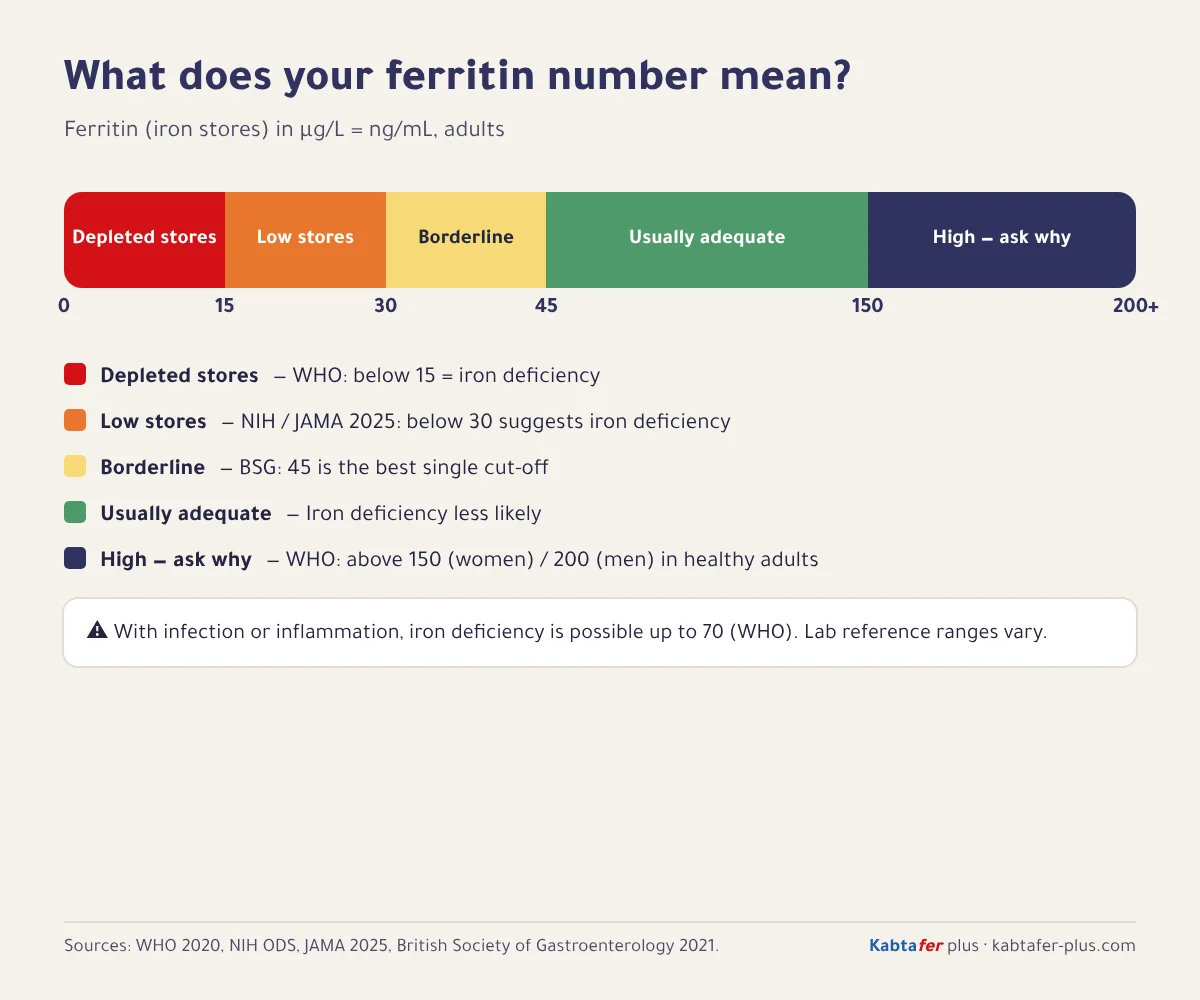
Ferritin is the blood test that best reflects how much iron your body has in storage. There is no single “normal range”: each lab prints its own, and some lower limits are set so low that real iron deficiency can be reported as normal. Clinical guidelines are more consistent. A ferritin below 15 µg/L means iron stores are empty, and below 30 µg/L (the same as 30 ng/mL) suggests iron deficiency in most adults. Because infection and inflammation push ferritin up, a “normal” result does not always rule out low iron. Read your result with your doctor, and find the cause of any low reading.
Have your lab report? Use our free iron blood test checker →
Key points
- Ferritin falls before haemoglobin does, so it can show low iron months before anemia appears.
- NIH ODS: below 30 mcg/L suggests iron deficiency; below 10 mcg/L suggests iron-deficiency anemia.
- WHO raises the cut-off to 70 µg/L in adults who have infection or inflammation.
- Lab lower limits vary widely; a 2024 review found a median lower limit of just 8 µg/L for women.
What is ferritin?
Ferritin is the protein that stores iron inside your cells, including in the liver and bone marrow. A small amount circulates in the blood, and the level in a blood sample tracks the size of your stores. Serum iron, by contrast, only shows the iron in your bloodstream at the moment of the test.
The NIH Office of Dietary Supplements describes iron deficiency in three stages:
- Storage iron depletion: ferritin falls; haemoglobin is not yet affected.
- Iron deficiency without anemia: stores are depleted and transferrin saturation drops, but haemoglobin is usually still in the normal range.
- Iron-deficiency anemia: stores are exhausted and haemoglobin falls.
Ferritin is the earliest of these signals. That is why a woman can be told her blood count is “fine” while her ferritin is already low. We cover that middle stage in detail in iron deficiency without anemia.
What is the normal range for ferritin?
Every lab sets its own reference range, based on its equipment and the population it measured. The problem is that these ranges were usually built from people who were never checked for iron deficiency. A systematic review by Truong and colleagues (Lancet Haematology, 2024) looked at where ferritin reference intervals come from. Across 37 general-population studies, the median lower limit of normal was 8 µg/L for females and 25 µg/L for males. The authors concluded that these limits “might not be rooted in rigorous scientific evidence” and recommended evidence-based clinical decision limits instead.
In practice, this means a ferritin of 12 µg/L may sit inside your lab’s printed range but still meet the WHO definition of iron deficiency. Use the range on your own report as a starting point, and compare it with the clinical cut-offs below together with your doctor.
Ferritin cut-offs used by guidelines
| Source | Ferritin | What it means |
|---|---|---|
| WHO 2020 (apparently healthy, age 5+, including adults) | <15 µg/L | Iron deficiency |
| WHO 2020 (infection or inflammation, age 5+) | <70 µg/L | May indicate iron deficiency |
| NIH ODS | <30 mcg/L / <10 mcg/L | Suggests iron deficiency / suggests iron-deficiency anemia |
| JAMA 2025 review | <30 ng/mL, or TSAT <20% | Iron deficiency in adults |
| BSG 2021 | <15 / <30 / 45 / >150 µg/L | Absent stores / low stores / best balance of sensitivity and specificity / absolute deficiency unlikely |
The numbers differ because they do different jobs. WHO’s 15 µg/L is designed to be very specific for healthy people and populations. Clinical guidelines such as the BSG and the JAMA 2025 review use 30 or higher so that fewer people with treatable iron deficiency are missed. For the full set of blood count values (haemoglobin, MCV, RDW), see your anemia blood test explained.
What does low ferritin mean?
Low ferritin almost always means your iron stores are running down. It does not tell you why. The next question your doctor will ask is what is causing the loss or the shortfall. Common causes listed by StatPearls and the NIH ODS include:
- Blood loss: heavy periods account for about 33–41% of iron-deficiency anemia in women of reproductive age; bleeding from the gut can be silent. See heavy periods and low ferritin.
- Poor absorption: coeliac disease, H. pylori, atrophic gastritis, bariatric surgery and long-term acid-reducing tablets.
- Higher need: pregnancy, growth spurts in children and teenagers, and regular blood donation (25–35% of regular donors become iron deficient).
- Low intake: restrictive or vegetarian diets, where iron bioavailability is about 5–12% versus 14–18% for mixed diets.
The BSG advises that men and post-menopausal women with iron-deficiency anemia should have the gut investigated. A low ferritin is a finding to follow up, not something to self-treat and forget.
Ferritin levels in women
Women of reproductive age are the group most likely to have low ferritin, mainly because of monthly blood loss and pregnancy. The JAMA 2025 review estimates that in high-income countries about 38% of non-pregnant women of reproductive age have iron deficiency without anemia, and about 13% have iron-deficiency anemia. In the UAE, WHO’s modelled estimate puts anemia in women aged 15–49 at 28.2% (2023, with a wide uncertainty range), and a 2026 study of UAE university students found anemia in 60.7% of female students. Low ferritin without anemia is likely more common still. More regional data is on our anemia in the UAE and GCC page.
In the first trimester of pregnancy WHO uses the same <15 µg/L threshold; see anemia in pregnancy.
Why ferritin can look normal when iron is low
Ferritin is also an acute-phase protein: it rises during infection and in long-term inflammatory conditions such as inflammatory bowel disease. A person can therefore have low iron stores and a ferritin that looks normal. This is why WHO suggests a threshold of 70 µg/L in adults with infection or inflammation, and why doctors often add transferrin saturation (TSAT). A TSAT below 20% supports iron deficiency even when ferritin is not clearly low (JAMA 2025). If you have recently been unwell, your doctor may repeat the test later.
What does high ferritin mean?
According to WHO, ferritin above 150 µg/L in menstruating women, or above 200 µg/L in men and non-menstruating women who are otherwise healthy, may indicate a risk of iron overload. WHO is equally clear that ferritin should not be used alone to identify iron overload, because inflammation and other conditions also raise it. A high result needs a doctor’s assessment, usually with transferrin saturation and other tests. Do not take iron or any iron-related supplement if your ferritin is high unless your doctor advises it.
Small red cells but normal ferritin?
If your MCV is low but ferritin is normal, iron deficiency is less likely to be the reason. In the UAE, a common alternative is thalassaemia trait, which iron does not correct. Iron deficiency and thalassaemia trait can also exist together. Read thalassemia trait vs iron deficiency.
What to do with a low ferritin result
- Take the full report to your doctor: ferritin, haemoglobin, MCV and, if done, TSAT and CRP.
- Ask what is likely causing the low level and whether further tests are needed.
- If iron is prescribed, follow the dose and timing your doctor or pharmacist gives. See iron deficiency anemia for how treatment works.
- Ask when to repeat the test; ferritin takes time to refill. If you are still tired on iron, raise it at follow-up.
- Build meals that help absorption: vitamin C with plant iron, and karak, tea and coffee away from iron-rich meals (NIH ODS).
Where Kabtafer Plus fits
Kabtafer Plus is an iron-free food supplement that supports absorption of iron from food. It does not contain iron, it is not a treatment for low ferritin or anemia, and it does not replace iron prescribed by your doctor. It is not for people with high ferritin or iron overload, or for thalassaemia carriers without iron deficiency. Its evidence comes from small studies of the related Italian formulation Captafer, summarised on our research page. Speak to your doctor before starting any supplement.
Read next: Iron panel explained: TIBC and transferrin saturation · High ferritin: causes and when to worry
Frequently asked questions
What is a normal ferritin level for a woman?
Lab ranges differ, and some lower limits are very low. Clinical guidelines generally treat ferritin below 30 µg/L (ng/mL) as suggesting iron deficiency in adults, and below 15 µg/L as empty stores. Your doctor will interpret your result with your other tests.
Is ferritin of 20 low?
By the NIH ODS, JAMA 2025 and BSG thresholds, 20 µg/L is below 30 and suggests low iron stores, even if it falls inside your lab’s printed range. It is above the WHO 15 µg/L threshold for healthy people, which is why advice can differ. Discuss it with your doctor.
Can ferritin be low while haemoglobin is normal?
Yes. Ferritin falls first, and haemoglobin usually stays normal until stores are exhausted. This stage is called iron deficiency without anemia.
Can I have low iron with a normal ferritin?
Yes, if you have infection or inflammation, which raise ferritin. WHO suggests a threshold of 70 µg/L in that situation, and doctors may also check transferrin saturation.
Are ng/mL and µg/L different?
No. They are the same unit, so a ferritin of 25 ng/mL equals 25 µg/L.
Is high ferritin always iron overload?
No. Inflammation and other conditions raise ferritin, and WHO says ferritin should not be used alone to identify iron overload. Your doctor will decide which further tests you need.
Sources
- World Health Organization. WHO guideline on use of ferritin concentrations to assess iron status in individuals and populations. 2020. NCBI Bookshelf; summary: WHO eLENA
- NIH Office of Dietary Supplements. Iron: Fact Sheet for Health Professionals. ods.od.nih.gov
- Auerbach M, DeLoughery TG, Tirnauer JS. Iron deficiency in adults: a review. JAMA 2025;333(20):1813–1823. PMID 40159291
- Snook J, et al. British Society of Gastroenterology guidelines for the management of iron deficiency anaemia in adults. Gut 2021;70:2030–2051. gut.bmj.com
- Truong J, et al. The origin of ferritin reference intervals: a systematic review. Lancet Haematol 2024. PMID 38937026
- StatPearls. Iron Deficiency Anemia. StatPearls Publishing. NCBI Bookshelf
- WHO Global Health Observatory. Prevalence of anaemia in women of reproductive age (15–49), 2023 estimates. WHO GHO
- Platat C, et al. [Anaemia prevalence among UAE university students]. Front Public Health 2026;14:1780083. doi:10.3389/fpubh.2026.1780083
This article is for general education and does not replace advice from your doctor or pharmacist.