Kabtafer Plus Editorial Team · Last reviewed: 20 November 2026
Sources: NHS: common questions about ferrous sulfate, NHS: how and when to take ferrous sulfate, British Society of Gastroenterology iron deficiency anaemia guideline (2021), WHO ferritin guideline (2020), NIH Office of Dietary Supplements: Iron, and peer-reviewed studies (Stoffel, Lancet Haematol 2017; Tolkien, PLoS One 2015; von Siebenthal, Am J Hematol 2023; JAMA 2025 review).
The short answer
Iron tablets start working within weeks, but they take months to finish the job. The NHS says most people begin to feel better after 3 to 4 weeks, and it may take 2 to 4 months for the medicine to work fully. On a blood test, haemoglobin should rise by about 2 g/dL within around 4 weeks (BSG 2021). Your iron stores (ferritin) fill more slowly, so doctors usually advise carrying on for about 3 months after haemoglobin is back to normal.
Have your lab report? Use our free iron blood test checker →
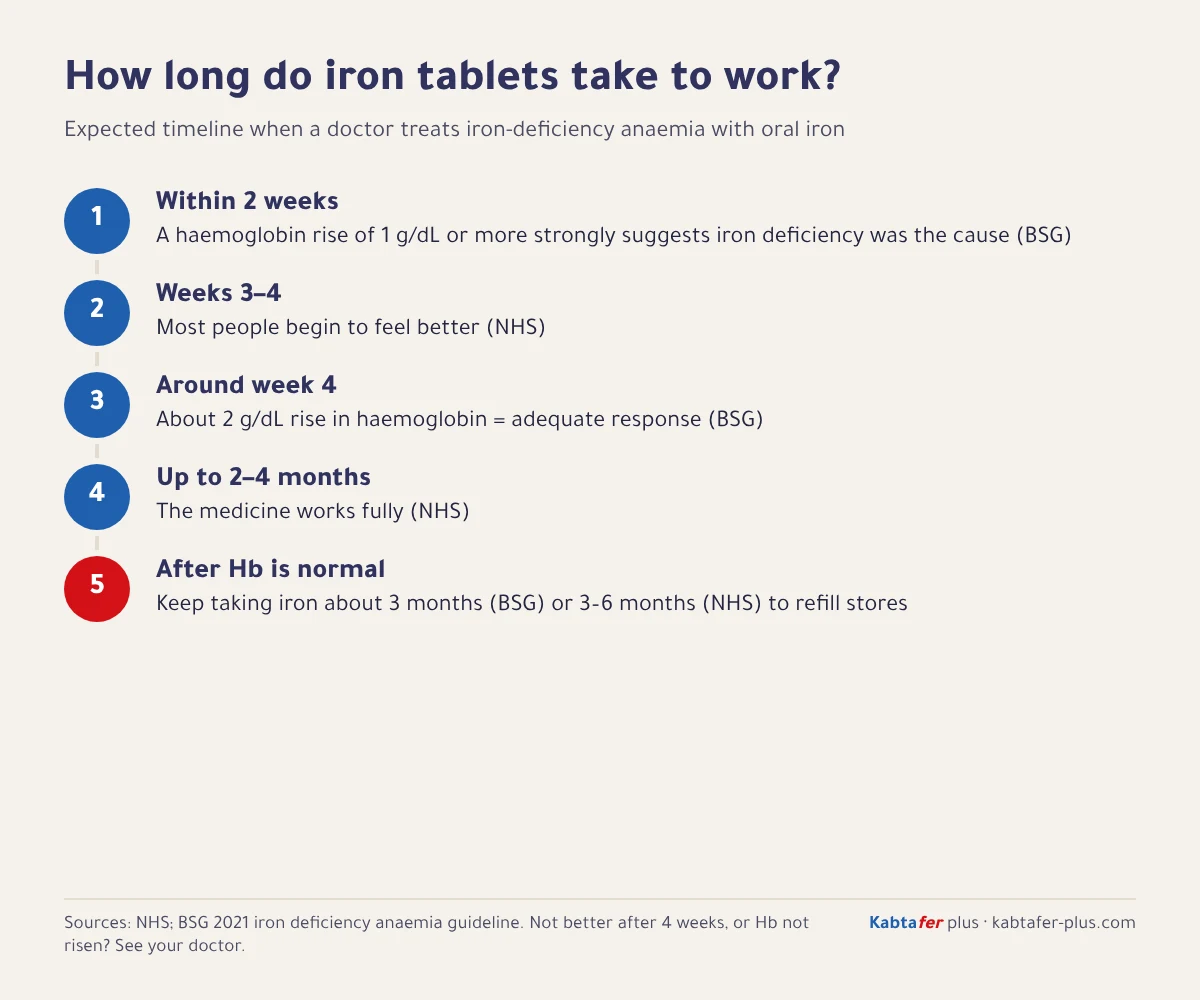
The timeline, step by step
| When | What should happen | Source |
|---|---|---|
| Within 2 weeks | A haemoglobin rise of 1 g/dL or more strongly suggests that iron deficiency was the cause of the anaemia | BSG 2021 |
| Weeks 3–4 | Most people begin to feel better | NHS |
| Within the first 4 weeks | Your doctor may order a blood test to check the iron is working | NHS |
| Around week 4 | A rise of about 2 g/dL in haemoglobin counts as an adequate response | BSG 2021 |
| Up to 2–4 months | The medicine works fully | NHS |
| After haemoglobin is normal | Keep taking iron for about 3 months (BSG) or 3 to 6 months (NHS) to build up stores | BSG 2021; NHS |
These timings are for people with iron-deficiency anaemia who take iron as prescribed. If you are taking iron to prevent anaemia, the NHS notes that you probably will not feel any different, which does not mean it is not working.
How long does it take ferritin to increase?
Ferritin is the stored iron, and it is the last thing to recover. Your body uses the iron it absorbs to make new red blood cells first, and only then fills its stores. That is why the BSG guideline advises continuing oral iron for about 3 months after haemoglobin has returned to normal, and the NHS says your doctor will usually advise 3 to 6 months after your condition has improved. There is no fixed number of weeks for ferritin: it depends on how low it started, how well you absorb iron, and whether you are still losing blood.
WHO defines low iron stores in adults as ferritin below 15 µg/L, and the NIH says below 30 µg/L suggests iron deficiency in clinical practice. Infection or inflammation can push ferritin up, so WHO uses a cut-off of 70 µg/L in that case. Ask your doctor what ferritin level they are aiming for and when to re-test. See ferritin levels explained.
Signs your iron tablets are working
- You feel better. Less tiredness and breathlessness, usually from about 3 to 4 weeks (NHS).
- Your haemoglobin goes up. This is the reliable sign: about 2 g/dL by week 4 (BSG). A blood test is the only way to know.
- Your ferritin rises on later tests. This shows the stores are filling.
Dark or black poo is a common side effect of iron tablets (NHS). It is not a sign of how much iron you are absorbing. See a doctor straight away if it is tar-like or has blood in it. Read black stools on iron.
What can slow it down
- Coffee, tea and breakfast. In iron-deficient women, coffee with the dose cut absorption by 54% and a breakfast with coffee cut it by 66% (von Siebenthal et al., Am J Hematol 2023). The NHS advises taking iron 30 minutes before eating or 2 hours after, and not with tea, coffee, eggs or dairy. In the UAE, that includes karak and Arabic coffee with the morning tablet. See the best time to take iron.
- Missed doses. Stomach side effects are common with oral iron (Tolkien et al., PLoS One 2015), and people who feel sick often skip doses. The BSG and NHS say your doctor may suggest taking it on alternate days if you get side effects. In a trial, alternate-day dosing raised the share of iron absorbed (Stoffel et al., Lancet Haematol 2017).
- Stomach-acid medicines. Medicines such as omeprazole can reduce iron absorption (NIH ODS). See PPIs and iron.
- Ongoing blood loss. Heavy periods account for about a third or more of iron-deficiency anaemia in women of reproductive age (NIH ODS). If losses continue, tablets may not keep up.
- Poor absorption from a gut condition. Coeliac disease, H. pylori and bariatric surgery can all block absorption. Intravenous iron may be needed (JAMA 2025).
When to see your doctor
See your doctor if you do not feel better after about 4 weeks, if a blood test shows haemoglobin has not risen, or if your symptoms get worse. The BSG guideline says that if oral iron does not work, the doctor should check whether it is being taken properly, whether bleeding is continuing, and whether something is blocking absorption, and should consider intravenous iron. Read oral iron not working? 7 reasons and still tired on iron.
Where Kabtafer Plus fits
Kabtafer Plus is an iron-free food supplement that supports the absorption of iron from your food. It does not treat anaemia, replace the iron your doctor prescribes, or shorten the treatment timeline above. In laboratory studies, carbohydrate fractions from fish, the type of compound the Kabtafer Plus formula is based on, increased iron uptake 3 to 5 times (Huh et al., J Nutr 2004). Each tablet contains hydrolysed marine fish cartilage 400 mg, vitamin C 50 mg, vitamin E 30 mg, folic acid 400 mcg, zinc 7.5 mg and copper 0.6 mg. Because iron and zinc can interact, ask your pharmacist how to space it from a prescribed iron tablet. See the published studies.
Read next: How long does iron stay in your system? · Iron tablets and diarrhea
Frequently asked questions
How long do iron tablets take to work?
Most people begin to feel better after 3 to 4 weeks, and it can take 2 to 4 months for the medicine to work fully (NHS). Haemoglobin should rise by about 2 g/dL within around 4 weeks (BSG).
How long does it take for iron levels to go up?
Haemoglobin rises first, often by 1 g/dL or more within 2 weeks. Ferritin, your stored iron, rises more slowly, which is why treatment continues for about 3 months after haemoglobin is normal.
How long should I take iron tablets for?
For iron-deficiency anaemia, usually several months: the NHS says your doctor will usually advise 3 to 6 months after your condition has improved. Take it for as long as your doctor tells you to.
Why do I not feel better after a week?
That is expected. Feeling better usually takes 3 to 4 weeks. If you still feel no better after about 4 weeks, ask your doctor for a blood test.
Does taking iron every other day make it slower?
Alternate-day dosing is an option your doctor may suggest if you get side effects (NHS, BSG). In a trial, a larger share of each dose was absorbed when it was taken every other day (Stoffel 2017). Ask your doctor before changing your dose.
Can I take my iron tablet during Ramadan?
Yes, at suhoor or iftar, but not with Arabic coffee, tea or laban. Taking it 2 hours after iftar, or 30 minutes before suhoor, follows the NHS timing advice. See Ramadan fasting and iron.
Will Kabtafer Plus make my iron tablets work faster?
No such claim is made. Kabtafer Plus supports the absorption of iron from food; it is not a treatment and does not replace prescribed iron.
Sources
- NHS. Common questions about ferrous sulfate (When will I feel better?). nhs.uk
- NHS. How and when to take ferrous sulfate (How long to take it for). nhs.uk
- NHS. Side effects of ferrous sulfate. nhs.uk
- Snook J, Bhala N, Beales ILP, et al. British Society of Gastroenterology guidelines for the management of iron deficiency anaemia in adults. Gut 2021;70(11):2030–2051. gut.bmj.com
- World Health Organization. WHO guideline on use of ferritin concentrations to assess iron status in individuals and populations. 2020. ncbi.nlm.nih.gov
- NIH Office of Dietary Supplements. Iron: Fact Sheet for Health Professionals. ods.od.nih.gov
- Auerbach M, DeLoughery TG, Tirnauer JS. Iron deficiency in adults: a review. JAMA 2025;333(20):1813–1823. PubMed
- Stoffel NU, Cercamondi CI, Brittenham G, et al. Iron absorption from oral iron supplements given on consecutive versus alternate days and as single morning doses versus twice-daily split dosing in iron-depleted women. Lancet Haematol 2017;4(11):e524–e533. doi:10.1016/S2352-3026(17)30182-5
- Tolkien Z, Stecher L, Mander AP, Pereira DIA, Powell JJ. Ferrous sulfate supplementation causes significant gastrointestinal side-effects in adults: a systematic review and meta-analysis. PLoS One 2015;10(2):e0117383. plos.org
- von Siebenthal HK, Moretti D, Zimmermann MB, Stoffel NU. Effect of dietary factors and time of day on iron absorption from oral iron supplements in iron deficient women. Am J Hematol 2023;98(9):1356–1363.
- Huh EC, Hotchkiss A, Brouillette J, Glahn RP. Carbohydrate fractions from cooked fish promote iron uptake by Caco-2 cells. J Nutr 2004;134(7):1681–1689.
This article is for general education and does not replace advice from your doctor or pharmacist.